

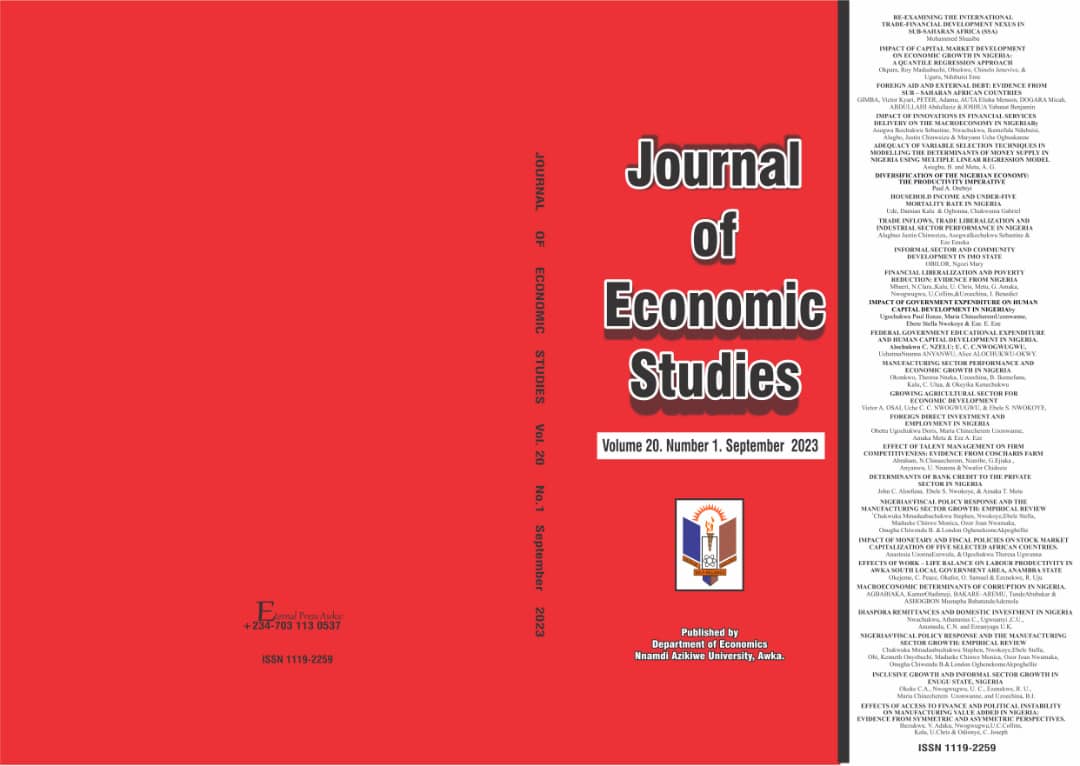
TOWARD A SUSTAINABLE BLUE ECONOMY: EXAMINING THE EFFECT OF TRADE, AND ECONOMIC GROWTH ON GREENHOUSE GAS EMISSIONS IN NIGERIA
- Open access
- Peer reviewed
- CC BY 4.0
ISSN 1119-2259
Authors
- Ibrahim Aminu Jamiu Corresponding author
- Muhammed Shamwil
- Abdullahi Ibrahim
Abstract
The concept of blue economy first introduced in 2010, highlights the use of marine resources for sustainable economic growth, jobs creation, marine health, and to improve living standards. However, climate change in form of global warming, ocean acidification, and lack of knowledge about the ocean resources posit serious challenges for sustainable blue economy. Therefore, the main objective of this study is to investigate the dynamic effect of greenhouse gas emissions, economic growth, trade openness and financial development on blue economy resources in Nigeria spanning the period from 1990 to 2022. The innovative dynamic autoregressive distributed lag (D-ARDL) model was employed to achieve this objective, while fully modified ordinary least square (FMOLS) and canonical cointegrating regression (CCR) were applied for robustness check. The results of the dynamic ARDL model indicate that a rise in greenhouse gas emissions and economic growth raise blue economy resources both in the short term and in the long-run, Similarly, trade openness and financial development are positively linked to blue economy resources. Finally, the results from the FMOL and CCR models confirmed the findings of the dynamic ARDL model. Based on the findings, the study recommends that, government should encourage the promotion and preservation of the blue economy resources in Nigeria, while leveraging sustainable economy, trade and financial development and reducing greenhouse gas (GHG) emissions, through the use of environmentally friendly aquaculture systems such as Integrated Multi-Trophic Aquaculture (IMTA), Recirculating Aquaculture Systems (RAS), and organic aquaculture. These methods reduce environmental impact, improve fish health, and increase production efficiency.