

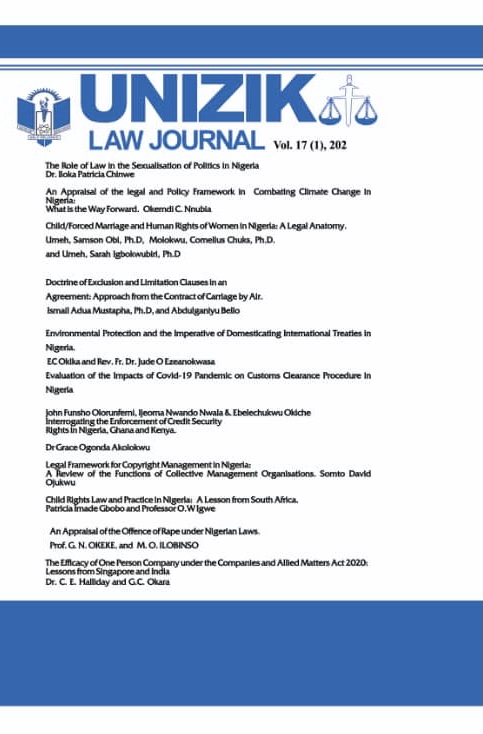
Child/Forced Marriage and Human Rights of Women in Nigeria: A Legal Anatomy
- Open access
- Peer reviewed
- CC BY 4.0
Authors
- Samson Obi Umeh Corresponding author
- Cornelius Chuks Molokwu
- Sarah Igbokwubiri, Umeh
Abstract
It is a notorious fact that in patriarchal societies such as those of Nigeria, women are disadvantaged bydiscriminatory customary practices that assigned gender roles on them which subordinate them to men.This has mounted immense pressure on women such that they keep struggling in order to be seen in allspheres of life.171 The most highlighted of these gender discriminatory customary practices ischild/forced marriage. It is unarguable that the rights of the child all over the world are considered to beparamount, inalienable and inderogable. This is why there have been several outcries against thecontinued practice of child/forced marriage in most developing, underdeveloped and the Arab countriesof the world. The danger associated with child/forced marriage is legion and if not urgently nipped onthe bud, will reduce the women folk to mere logs of wood. Using empirical and doctrinal researchmethods, this work critically examined the practice of child/forced marriage in Nigeria and found outthat this customary practice still thrives in Nigeria, mostly in Northern parts of Nigeria.Recommendations were made strict adherence to which shall throw this menace into the oblivion.